
Skip Navigation
Skip to contents

Diabetes Metab J : Diabetes & Metabolism Journal

Search
OPEN ACCESS

Search

Page Path
HOME > Search
2 "Immune checkpoint inhibitors"
Filter
Filter
Article category
Keywords
Publication year
Authors
Funded articles
Original Article
Metabolic Risk/Epidemiology
Article image
Risk Factors and Survival Outcomes of Immune Checkpoint Inhibitor-Induced Type 1 Diabetes Mellitus: A Retrospective Cohort Study
Sang-hyeok Go, Yun Kyung Cho, Eun Hee Koh
Diabetes Metab J. 2026;50(1):115-126.   Published online July 22, 2025
DOI: https://doi.org/10.4093/dmj.2024.0455
  • 1,876 View
  • 61 Download
AbstractAbstract PDFPubReader   ePub   
Background
Immune checkpoint inhibitors (ICIs) have transformed the treatment of metastatic solid tumors; however, they induce immune-related adverse events, such as ICI-induced type 1 diabetes mellitus (ICI-T1DM), a rare but serious condition requiring lifelong insulin therapy. We aimed to identify the risk factors and survival outcomes associated with ICI-T1DM to optimize screening and mitigate adverse effects.
Methods
This retrospective cohort study analyzed 6,956 patients treated with ICIs at a tertiary care center between January 1, 2017, and February 28, 2023. ICI-T1DM was classified based on the need for persistent insulin therapy post-ICI and a C-peptide level <1.0 ng/mL. Patient demographics, clinical characteristics, treatment details, and survival outcomes were examined.
Results
ICI-T1DM was identified in 32 patients (0.46%) with a median onset time of 41 weeks. Significant risk factors included pre-existing diabetes (hazard ratio [HR], 2.352; 95% confidence interval [CI], 1.140 to 4.854), combination therapy with anti-programmed death-1 (PD-1)/programmed death-ligand 1 (PD-L1) and anti-cytotoxic T-lymphocyte-associated protein 4 (CTLA-4) inhibitors (HR, 3.666; 95% CI, 1.224 to 10.979), prolonged ICI treatment (≥12 weeks; HR, 4.789; 95% CI, 1.806 to 12.701), and thyroid dysfunction (HR, 4.027; 95% CI, 1.847 to 8.779). ICI-T1DM occurrence and thyroid dysfunction were associated with improved survival (HR, 0.224; 95% CI, 0.093 to 0.539; and HR, 0.616; 95% CI, 0.566 to 0.670).
Conclusion
Patients with pre-existing diabetes, combined anti–PD-1/PD-L1 and anti–CTLA-4 therapy, prolonged ICI treatment (≥12 weeks), and thyroid dysfunction are at high risk of developing ICI-T1DM. The observed survival benefits in patients with ICI-T1DM underscore the importance of aggressive glucose monitoring and patient education for early detection and management.
Review
Pathophysiology
Article image
Immune-Checkpoint Inhibitors-Induced Type 1 Diabetes Mellitus: From Its Molecular Mechanisms to Clinical Practice
Yun Kyung Cho, Chang Hee Jung
Diabetes Metab J. 2023;47(6):757-766.   Published online July 24, 2023
DOI: https://doi.org/10.4093/dmj.2023.0072
  • 16,153 View
  • 741 Download
  • 29 Web of Science
  • 36 Crossref
AbstractAbstract PDFPubReader   ePub   
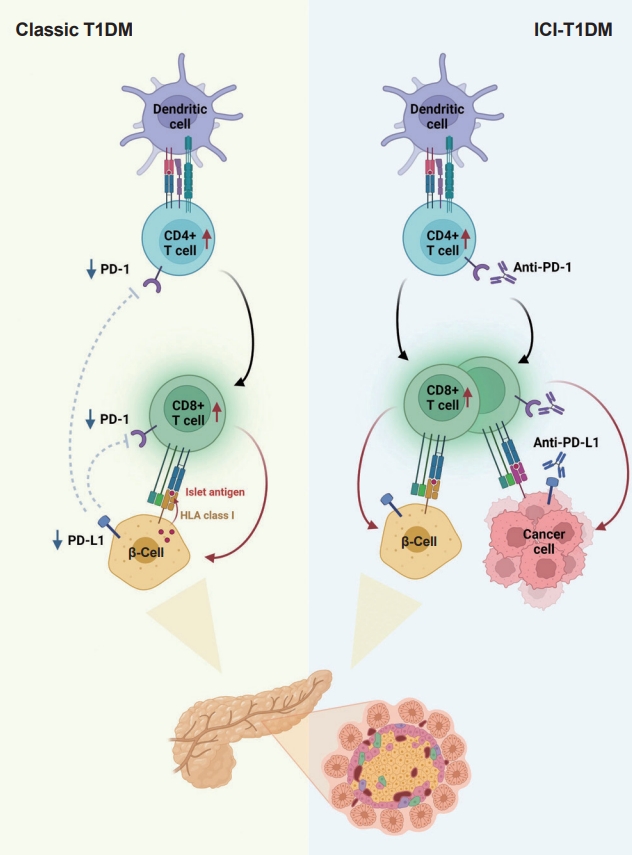
With the increasing use of immune-checkpoint inhibitors (ICIs), such as anti-cytotoxic T lymphocyte-associated antigen 4 (CTLA-4) and anti-programmed cell death-1 (PD-1), for the treatment of malignancies, cases of ICI-induced type 1 diabetes mellitus (ICI-T1DM) have been reported globally. This review focuses on the features and pathogenesis of this disease. T1DM is an immune-related adverse event that occurs following the administration of anti-PD-1 or anti-programmed death ligand-1 (PDL1) alone or in combination with anti-CTLA-4. More than half of the reported cases presented as abrupt-onset diabetic ketoacidosis. The primary mechanism of ICI-T1DM is T-cell stimulation, which results from the loss of interaction between PD-1 and PD-L1 in pancreatic islet. The similarities and differences between ICI-T1DM and classical T1DM may provide insights into this disease entity. ICI-T1DM is a rare but often life-threatening medical emergency that healthcare professionals and patients need to be aware of. Early detection of and screening for this disease is imperative. At present, the only known treatment for ICI-T1DM is insulin injection. Further research into the mechanisms and risk factors associated with ICI-T1DM development may contribute to a better understanding of this disease entity and the identification of possible preventive strategies.

Citations

Citations to this article as recorded by  
  • Adult-onset type 1 diabetes: early detection, differential diagnosis, and emerging disease-modifying therapies
    Robert Wagner, Martin Füchtenbusch, Michael Hummel, Martin Miszon, Andreas Pfützner, Susanne Reger-Tan, Tobias Wiesner
    Diabetes Research and Clinical Practice.2026; 231: 113047.     CrossRef
  • Risk Factors and Survival Outcomes of Immune Checkpoint Inhibitor-Induced Type 1 Diabetes Mellitus: A Retrospective Cohort Study
    Sang-hyeok Go, Yun Kyung Cho, Eun Hee Koh
    Diabetes & Metabolism Journal.2026; 50(1): 115.     CrossRef
  • Sintilimab-related fulminant autoimmune diabetes mellitus manifesting as diabetic ketoacidosis and rare insulin resistance: A case report and literature review
    Junhui Zhang, Yuping Zhang, Hongmei Li, Fang Deng, Liling Ma, Wenjing Yang, Hong Yang, Huiqing Yu, Bing Chen, Jiongyu Hu
    Endocrine Journal.2026; 73(1): 93.     CrossRef
  • Sodium-Glucose Cotransporter 2 Inhibitors as Emerging Anticancer Agents
    Yun Kyung Cho, Chang Hee Jung
    Diabetes & Metabolism Journal.2026; 50(1): 1.     CrossRef
  • Fulminant type 1 diabetes mellitus induced by tislelizumab in a patient with lung adenocarcinoma: a case report
    Yuanzhen Feng, Xiankang Cheng, Jiao Liu, Jun Qi, Limin Han
    Journal of Medical Case Reports.2026;[Epub]     CrossRef
  • Diabetic ketoacidosis and hyperglycaemic hyperosmolar syndrome in patients with cancer: A multicentre study
    Rabia K. Shahid, Qasem Haider, Sunil Yadav, Duc Le, Shahid Ahmed
    Clinical Medicine.2025; 25(1): 100262.     CrossRef
  • Immune checkpoint inhibitor‐related type 1 diabetes incidence, risk, and survival association
    Fumika Kamitani, Yuichi Nishioka, Miyuki Koizumi, Hiroki Nakajima, Yukako Kurematsu, Sadanori Okada, Shinichiro Kubo, Tomoya Myojin, Tatsuya Noda, Tomoaki Imamura, Yutaka Takahashi
    Journal of Diabetes Investigation.2025; 16(2): 334.     CrossRef
  • Management of Immunotherapy-Induced Type 1 Diabetes
    Veronica Brady
    Critical Care Nursing Clinics of North America.2025; 37(1): 93.     CrossRef
  • Type I Diabetes—A Rare Adverse Event Described in Patients Receiving Immunotherapy Versus a Side Effect from SARS-CoV-2 Infection
    Raluca-Ileana Pătru, Miruna Ghigeanu, Maria-Alexandra Barbu, Andreea Iuliana Ionescu, Antone-Iordache Ionuț-Lucian
    Reports.2025; 8(1): 31.     CrossRef
  • Immune Checkpoint Inhibitor-Induced Pancreatic Injury (ICI-PI) in Adult Cancer Patients: A Systematic Review and Meta-Analysis
    Cha Len Lee, Israt Jahan Riya, Ifrat Jahan Piya, Thiago Pimentel Muniz, Marcus Otho Butler, Samuel David Saibil
    Cancers.2025; 17(7): 1080.     CrossRef
  • Cemiplimab and diabetic ketoacidosis: a case report of a rare endocrinopathy associated with immune checkpoint inhibitors
    Anna Arecco, Cristian Petolicchio, Alessandro Pastorino, Enrica Teresa Tanda, Lara Vera, Mara Boschetti, Francesco Cocchiara, Davide Carlo Maggi, Diego Ferone, Federico Gatto
    Frontiers in Endocrinology.2025;[Epub]     CrossRef
  • Efficacy and adverse events of immune checkpoint inhibitors: evidence from non-small cell lung cancer and gastric cancer in Korea and Japan
    Mc Neil Valencia, Zeeshan Abbas, Seung Won Lee
    Precision and Future Medicine.2025; 9(1): 15.     CrossRef
  • Durvalumab‑induced type 1 diabetes mellitus in lung adenocarcinoma: A case report and literature review
    Huijing Dong, Shengfu Li, Yanmei Peng, Xu Zhang, Jiabin Zheng, Chongxiang Xue, Yumin Zheng, Yixuan Yu, Xingyu Lu, Zixin Hu, Huijuan Cui
    Oncology Letters.2025; 29(6): 1.     CrossRef
  • Pembrolizumab-Induced Hypothyroidism and Diabetes Mellitus: A Rare Case Presentation Post-Treatment
    Jeevan Perera, Shubham Bhanot
    Cureus.2025;[Epub]     CrossRef
  • Risk Factors Associated with the Development of Immune-Checkpoint Inhibitor Diabetes Mellitus: An Integrative Review
    Vivian Crowder, Veronica Brady
    Life.2025; 15(7): 1063.     CrossRef
  • Prenatal pembrolizumab exposure as the potential link among recurrent necrotizing enterocolitis, neonatal diabetes mellitus and exocrine pancreatic insufficiency: a case report
    Pasquale Castaldo, Luigi Altimari, Maria Grazia Capretti, Giulio Maltoni, Andrea Scozzarella, Vittoria Paoletti, Luigi Corvaglia, Arianna Aceti
    Italian Journal of Pediatrics.2025;[Epub]     CrossRef
  • Development of type 1 diabetes mellitus after nivolumab dose escalation: A case report
    Sayaka Mabuchi, Naoko Adachi, Atsushi Nagasawa, Satoshi Nabika
    Medicine.2025; 104(29): e43356.     CrossRef
  • Checkpoint Inhibitor-Associated Diabetes Mellitus Following Rapid Pancreatic Metastasis Resolution: Implications for Endocrine Toxicities in Immunotherapy
    Sinead Cadogan, Sadhbh Doherty, Deirdre Kelly, Nigel Glynn
    AACE Endocrinology and Diabetes.2025; 12(4): 339.     CrossRef
  • Immune Checkpoint Inhibitor-Induced Type 1 Diabetes Mellitus in a Patient With Melanoma: A Case Report
    Mati Shavit
    Cureus.2025;[Epub]     CrossRef
  • Genome-Wide Aggregated Trans Effects Analysis for Circulating Proteins Indicates a Key Role of Immune Checkpoints in Type 1 Diabetes
    Xuan Zhou, Andrii Iakovliev, Stuart McGurnaghan, Buddhiprabha Erabadda, Caroline Hayward, Paul M. McKeigue, Athina Spiliopoulou, Helen M. Colhoun
    Diabetes.2025; 74(10): 1873.     CrossRef
  • Natural coumarins as anti-diabetic agents: Mechanisms, therapeutic potential, and amelioration of diabetic complications
    Shahnaaz Khatoon, Raabia Naaz, Umam Khan, Fayeqa Qayyum, Shakir Ahamad, Mohammad Saquib, Mohd Kamil Hussain
    Phytomedicine.2025; 148: 157339.     CrossRef
  • Atezolizumab-Induced Thyroiditis and Immune Checkpoint Inhibitor (ICI)-Type 1 Diabetes Mellitus: Diagnostic and Therapeutic Challenges in ICI-Associated Endocrinopathies
    Rafal Al-Rubaye, Sabha Nadeem, Ahmed Abdulkader Zaki Ali Soliman
    Cureus.2025;[Epub]     CrossRef
  • Interconnected Mechanistic Pathways, Molecular Biomarkers, and Therapeutic Approach of Oral Cancer in Patients with Diabetes Mellitus
    Viviana Elian, Violeta Popovici, Mihnea Ioan Nicolescu, Alexandra Maria Nicolescu, Sorina Maria Aurelian, Emma Adriana Ozon
    Current Issues in Molecular Biology.2025; 47(11): 929.     CrossRef
  • Tislelizumab-induced fulminant type 1 diabetes mellitus (FT1D): A case report and literature review
    Xipeng Zhou, Peng Jiang, Mingxiang Chen, Jiashun Chen
    Medicine.2025; 104(47): e46310.     CrossRef
  • Immune Checkpoint Inhibitor-Associated Autoimmune Diabetes Mellitus: An Indian Case Series
    Medha N Rao, Aditi Chopra, Aditya G Hegde, Adarsh K S, Gunna Sriharsha
    Cureus.2025;[Epub]     CrossRef
  • Beyond Tumor Immunity: The Disruption of Endocrine and Infectious Homeostasis by Immune Checkpoint Inhibitors
    Ema Schönberger, Luka Švitek, Barbara Grubišić, Tara Cvijić Perić, Romana Marušić, Nika Vlahović Vlašić, Tomislav Kizivat, Silvija Canecki Varžić, Lorna Stemberger Marić, Ines Bilić Ćurčić
    International Journal of Molecular Sciences.2025; 26(23): 11619.     CrossRef
  • Immune Checkpoint Restoration as a Therapeutic Strategy to Halt Diabetes-Driven Atherosclerosis
    Dwaipayan Saha, Preyangsee Dutta, Abhijit Chakraborty
    Biology.2025; 14(12): 1731.     CrossRef
  • Research Advances of Immune Checkpoint Inhibitors Related Endocrine Adverse Events
    晶晶 王
    Advances in Clinical Medicine.2024; 14(02): 2706.     CrossRef
  • Immune checkpoint inhibitor‑associated diabetes mellitus in patients with HCC: Report of three cases and literature review
    Gaocheng Wang, Jingjing Wang, Shuilin Dong, Zhanguo Zhang, Wanguang Zhang, Jianping Zhao
    Experimental and Therapeutic Medicine.2024;[Epub]     CrossRef
  • Type 1 diabetes: immune pathology and novel therapeutic approaches
    Eleanor M. Ling, Joana R. N. Lemos, Khemraj Hirani, Matthias von Herrath
    Diabetology International.2024; 15(4): 761.     CrossRef
  • Pathophysiology, diagnosis, and management of immune checkpoint inhibitor-induced diabetes mellitus
    Eleni-Rafaela Kani, Eleftheria Karaviti, Dimitra Karaviti, Eleni Gerontiti, Ioanna A. Paschou, Katerina Saltiki, Katerina Stefanaki, Theodora Psaltopoulou, Stavroula A. Paschou
    Endocrine.2024; 87(3): 875.     CrossRef
  • Use pembrolizumab may cause acute and severe adverse reactions: a case report and review
    Linna Ouyang, Huixing Liu, Zhixiang Tang, Rui Wu, Yujie Zhong, Haibin Chen
    International Journal of Surgery Oncology.2024; 9(3): 40.     CrossRef
  • Pembrolizumab-Induced Insulin-Dependent Diabetes Mellitus in a Patient With Triple-Negative Breast Cancer: A Rare Immune-Related Adverse Event
    Mirac Burak Tak, Zaid Munir, Ahmet Aydin
    Cureus.2024;[Epub]     CrossRef
  • Diabetes and the associated complications: The role of antioxidants in diabetes therapy and care
    Lowell Dilworth, Dewayne Stennett, Aldeam Facey, Felix Omoruyi, Shada Mohansingh, Felix O. Omoruyi
    Biomedicine & Pharmacotherapy.2024; 181: 117641.     CrossRef
  • Fulminant type 1 diabetes mellitus: a neglected but high-risk adverse event associated with immune checkpoint inhibitors
    Kelin Meng, Shengling Fu, Yaochen Huang, Wei Chen, Wenbin Zou
    Expert Opinion on Drug Safety.2024; : 1.     CrossRef
  • Fulminant Type 1 Diabetes Mellitus Leading to Diabetic Ketoacidosis and Mesenteric Ischemia With Necrosis Following Pembrolizumab Administration: A Case Report
    Mayu Ueki, Takeshi Fukuda, Kenta Oue, Takuma Wada, Toshiyuki Sumi
    Cureus.2024;[Epub]     CrossRef

Diabetes Metab J : Diabetes & Metabolism Journal
Close layer
TOP
