
 KDA
KDA
- Current
- Browse
- Collections
-
For contributors
- For Authors
- Instructions to authors
- Article processing charge
- e-submission
- For Reviewers
- Instructions for reviewers
- How to become a reviewer
- Best reviewers
- For Readers
- Readership
- Subscription
- Permission guidelines
- About
- Editorial policy
Search
- Page Path
- HOME > Search
Original Articles
- Metabolic Risk/Epidemiology
- Association of Myosteatosis with Nonalcoholic Fatty Liver Disease, Severity, and Liver Fibrosis Using Visual Muscular Quality Map in Computed Tomography
- Hwi Seung Kim, Jiwoo Lee, Eun Hee Kim, Min Jung Lee, In Young Bae, Woo Je Lee, Joong-Yeol Park, Hong-Kyu Kim, Chang Hee Jung
- Diabetes Metab J. 2023;47(1):104-117. Published online January 26, 2023
- DOI: https://doi.org/10.4093/dmj.2022.0081
- 3,240 View
- 176 Download
- 7 Web of Science
- 6 Crossref
-
 Abstract
 PDF
PDF Supplementary Material
 PubReader
  ePub
ePub - Background
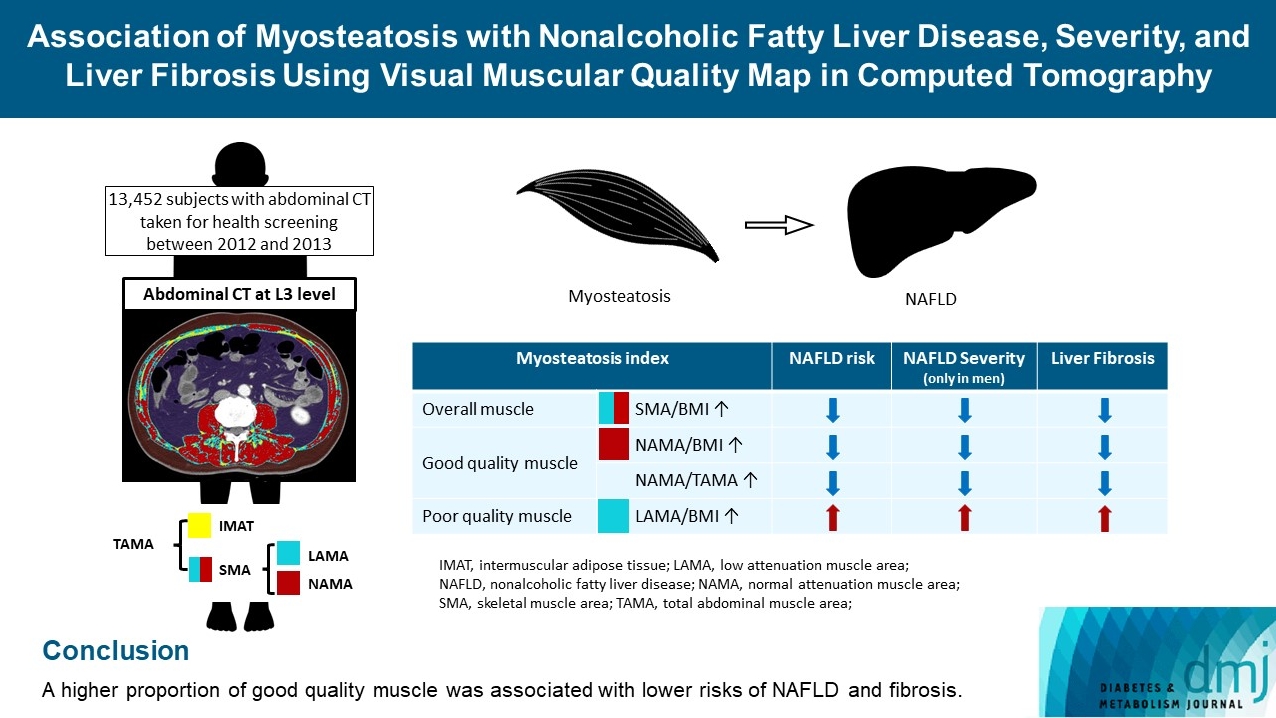
The association of myosteatosis measured using visual muscular quality map in computed tomography (CT) with nonalcoholic fatty liver disease (NAFLD), its severity, and fibrosis was analyzed in a large population.
Methods
Subjects (n=13,452) with abdominal CT between 2012 and 2013 were measured total abdominal muscle area (TAMA) at L3 level. TAMA was segmented into intramuscular adipose tissue and skeletal muscle area (SMA), which was further classified into normal attenuation muscle area (NAMA) and low attenuation muscle area (LAMA). The following variables were adopted as indicators of myosteatosis: SMA/body mass index (BMI), NAMA/BMI, NAMA/TAMA, and LAMA/BMI. NAFLD and its severity were assessed by ultrasonography, and liver fibrosis was measured by calculating the NAFLD fibrosis score (NFS) and fibrosis-4 index (FIB-4) scores.
Results
According to multiple logistic regression analyses, as quartiles of SMA/BMI, NAMA/BMI, and NAMA/TAMA increased, the odds ratios (ORs) for NAFLD decreased in each sex (P for trend <0.001 for all). The ORs of moderate/severe NAFLD were significantly higher in the Q1 group than in the Q4 group for SMA/BMI, NAMA/BMI, and NAMA/TAMA in men. The ORs of intermediate/high liver fibrosis scores assessed by NFS and FIB-4 scores increased linearly with decreasing quartiles for SMA/BMI, NAMA/BMI, and NAMA/TAMA in each sex (P for trend <0.001 for all). Conversely, the risk for NAFLD and fibrosis were positively associated with LAMA/BMI quartiles in each sex (P for trend <0.001 for all).
Conclusion
A higher proportion of good quality muscle was associated with lower risks of NAFLD and fibrosis. -
Citations
Citations to this article as recorded by
- Association of Myosteatosis with Nonalcoholic Fatty Liver Disease, Severity, and Liver Fibrosis Using Visual Muscular Quality Map in Computed Tomography (Diabetes Metab J 2023;47:104-17)
Hwi Seung Kim, Hong-Kyu Kim, Chang Hee Jung
Diabetes & Metabolism Journal.2023; 47(2): 304. CrossRef - Association of Myosteatosis with Nonalcoholic Fatty Liver Disease, Severity, and Liver Fibrosis Using Visual Muscular Quality Map in Computed Tomography (Diabetes Metab J 2023;47:104-17)
Eun Roh
Diabetes & Metabolism Journal.2023; 47(2): 301. CrossRef - Sarcopenia, a condition shared by various diseases: can we alleviate or delay the progression?
Giovanni Tarantino, Gaia Sinatti, Vincenzo Citro, Silvano Santini, Clara Balsano
Internal and Emergency Medicine.2023; 18(7): 1887. CrossRef - Association of Visceral Fat Obesity, Sarcopenia, and Myosteatosis with Non-Alcoholic Fatty Liver Disease without Obesity
Hong-Kyu Kim, Sung-Jin Bae, Min Jung Lee, Eun Hee Kim, Hana Park, Hwi Seung Kim, Yun Kyung Cho, Chang Hee Jung, Woo Je Lee, Jaewon Choe
Clinical and Molecular Hepatology.2023; 29(4): 987. CrossRef - Current view of the surgical anatomy of the anterolateral abdominal wall muscles and their aponeuroses
A.V. Pavlov, A.S. Baranova, A.V. Fedoseyev, A.I. Vvedensky, G.S. Lazutina, N.V. Ovchinnikova, I.V. Bakharev
Operativnaya khirurgiya i klinicheskaya anatomiya (Pirogovskii nauchnyi zhurnal).2023; 7(3): 44. CrossRef - Muscle Fat Content Is Associated with Nonalcoholic Fatty Liver Disease and Liver Fibrosis in Chinese Adults
W. Guo, X. Zhao, D. Cheng, X. Liang, M. Miao, X. Li, J. Lu, N. Xu, Shuang Hu, Qun Zhang
The Journal of nutrition, health and aging.2023; 27(11): 960. CrossRef
- Association of Myosteatosis with Nonalcoholic Fatty Liver Disease, Severity, and Liver Fibrosis Using Visual Muscular Quality Map in Computed Tomography (Diabetes Metab J 2023;47:104-17)
- Complications
- Renal Tubular Damage Marker, Urinary N-acetyl-β-D-Glucosaminidase, as a Predictive Marker of Hepatic Fibrosis in Type 2 Diabetes Mellitus
- Hae Kyung Kim, Minyoung Lee, Yong-ho Lee, Eun Seok Kang, Bong-Soo Cha, Byung-Wan Lee
- Diabetes Metab J. 2022;46(1):104-116. Published online July 13, 2021
- DOI: https://doi.org/10.4093/dmj.2020.0273
- 5,677 View
- 191 Download
- 4 Web of Science
- 5 Crossref
-
 Graphical Abstract
Abstract
PDFSupplementary MaterialPubReader ePub
Graphical Abstract
Abstract
PDFSupplementary MaterialPubReader ePub - Background
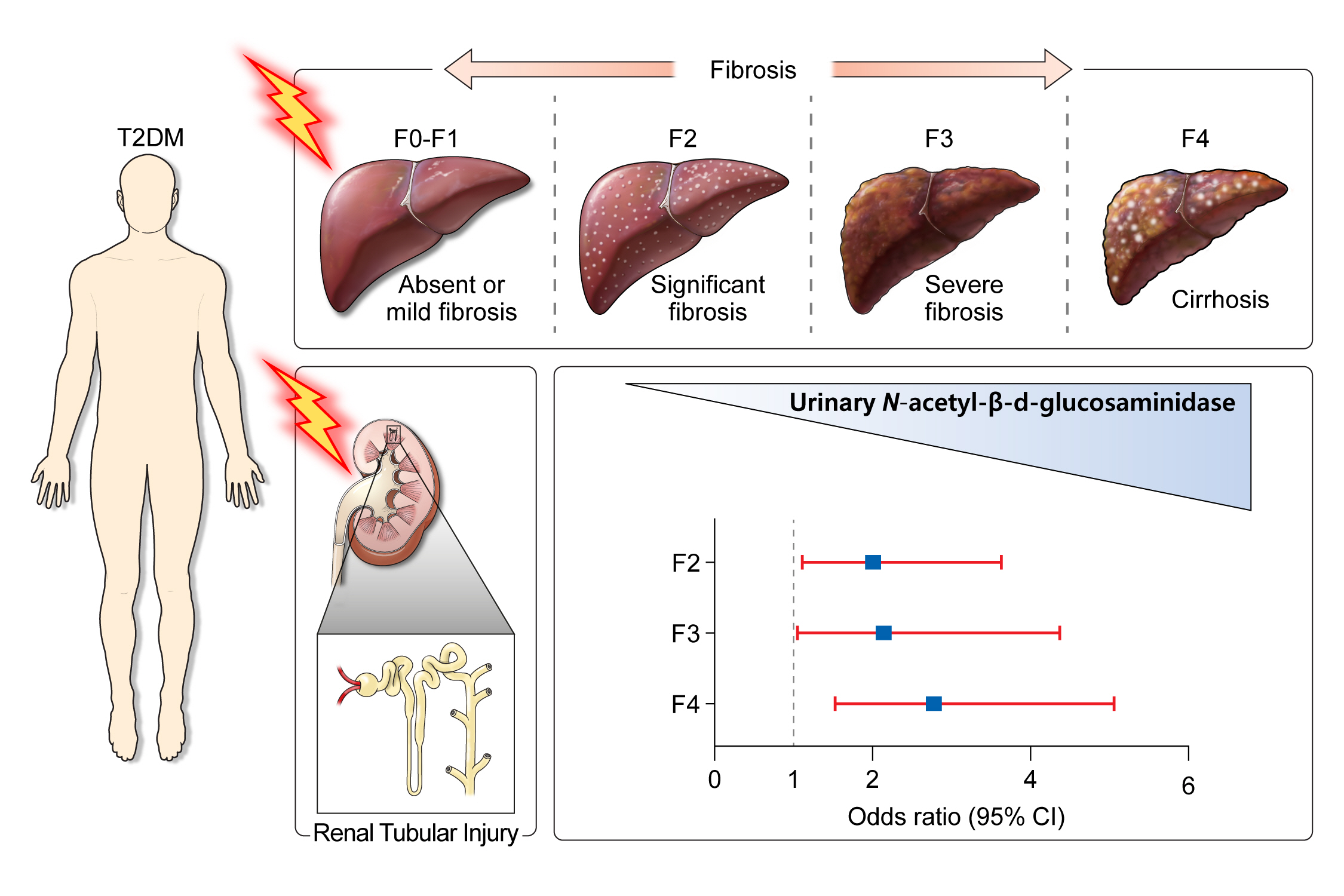
Non-alcoholic steatohepatitis is closely associated with the progression of diabetic kidney disease (DKD) in type 2 diabetes mellitus (T2DM). We investigated whether urinary N-acetyl-β-D-glucosaminidase (u-NAG), an early renal tubular damage biomarker in DKD, could be related to the degree of hepatic fibrosis in patients with T2DM.
Methods
A total of 300 patients with T2DM were enrolled in this study. Hepatic steatosis and fibrosis were determined using transient elastography. The levels of urinary biomarkers, including u-NAG, albumin, protein, and creatinine, and glucometabolic parameters were measured.
Results
Based on the median value of the u-NAG to creatinine ratio (u-NCR), subjects were divided into low and high u-NCR groups. The high u-NCR group showed a significantly longer duration of diabetes, worsened hyperglycemia, and a more enhanced hepatic fibrosis index. A higher u-NCR was associated with a greater odds ratio for the risk of higher hepatic fibrosis stage (F2: odds ratio, 1.99; 95% confidence interval [CI], 1.04 to 3.82). Also, u-NCR was an independent predictive marker for more advanced hepatic fibrosis, even after adjusting for several confounding factors (β=1.58, P<0.01).
Conclusion
The elevation of u-NAG was independently associated with a higher degree of hepatic fibrosis in patients with T2DM. Considering the common metabolic milieu of renal and hepatic fibrosis in T2DM, the potential use of u-NAG as an effective urinary biomarker reflecting hepatic fibrosis in T2DM needs to be validated in the future. -
Citations
Citations to this article as recorded by- Intermittent fasting plus early time-restricted eating versus calorie restriction and standard care in adults at risk of type 2 diabetes: a randomized controlled trial
Xiao Tong Teong, Kai Liu, Andrew D. Vincent, Julien Bensalem, Bo Liu, Kathryn J. Hattersley, Lijun Zhao, Christine Feinle-Bisset, Timothy J. Sargeant, Gary A. Wittert, Amy T. Hutchison, Leonie K. Heilbronn
Nature Medicine.2023; 29(4): 963. CrossRef - Significance of Diabetic Kidney Disease Biomarkers in Predicting Metabolic-Associated Fatty Liver Disease
Jaehyun Bae, Byung-Wan Lee
Biomedicines.2023; 11(7): 1928. CrossRef - Abdominal adipose tissue and type 2 diabetic kidney disease: adipose radiology assessment, impact, and mechanisms
Fei Lu, Jinlei Fan, Fangxuan Li, Lijing Liu, Zhiyu Chen, Ziyu Tian, Liping Zuo, Dexin Yu
Abdominal Radiology.2023; 49(2): 560. CrossRef - β‐Amyrin ameliorates diabetic nephropathy in mice and regulates the miR‐181b‐5p/HMGB2 axis in high glucose‐stimulated HK‐2 cells
Wenhua Xu, Hongwu Zhang, Qinfeng Zhang, Jialan Xu
Environmental Toxicology.2022; 37(3): 637. CrossRef - High Glycated Hemoglobin Instead of High Body Mass Index Might Increase the Urine N-Acetyl-β-D-glucosaminidase Con-Centration in Children and Adolescents with Diabetes Mellitus
Jin-Soon Suh, Kyoung Soon Cho, Seul Ki Kim, Shin-Hee Kim, Won Kyoung Cho, Min Ho Jung, Moon Bae Ahn
Life.2022; 12(6): 879. CrossRef
- Intermittent fasting plus early time-restricted eating versus calorie restriction and standard care in adults at risk of type 2 diabetes: a randomized controlled trial
 First
First Prev
Prev




